
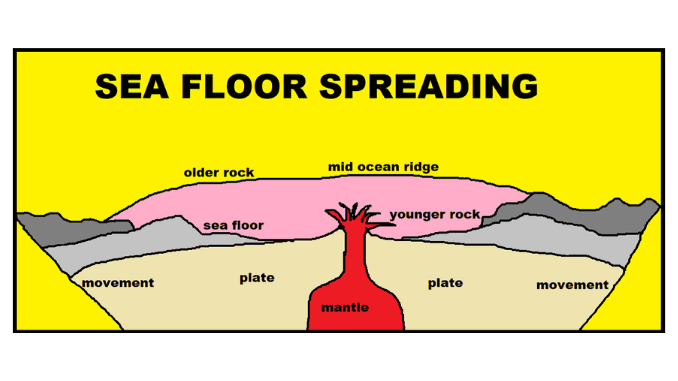
What is sea floor spreading?
Sea floor spreading is a geological process in which tectonic plates floating on the asthenosphere split apart from each other.
Continental drift
It refers to the movement of the continents relative to each other. Professor Alfred Wegener, a German scholar, put forward his theory of drifting continents in 1912 and revised it in 1924. According to Wagner’s continental drift theory:-
- Several continental landmasses were closely aggregated and formed one supercontinent in the Upper Carboniferous period.
- This supercontinent was called Pangaea by Wagner. Pangaea was surrounded by a vast ocean called Panthalassa.
- The northern part of Pangaea comprised North America, Europe, and Asia and was known as Laurasia.
- The southern part of Pangaea comprised South America, Africa, Peninsular India, Australia, and Antarctica and was known as Gondwanaland.
- Both Laurasia and Gondwanaland were separated by a narrow and shallow sea known as the Tethys Sea. The drifting process started in the Upper Carboniferous Age about 250-300 million years ago.
Post drift
Wegener collected several pieces of evidence in support of his continental drift theory. Some of the evidence of post drift is-
1. Mountain belt
The ancient mountain belt, 470 to 350 million years old, was created by a continuous belt of geological activity. These mountains are now separated by the Atlantic Ocean.
2. Paleomagnetism
The synchronization of magnetic minerals in rocks shows that the Earth’s magnetic field has changed over time, proving continents have moved.
3. Fossil
Remains of similar plants and elements are found on continents that are now widely separated by oceans, indicating they were once connected.
4. Jigsaw fit
The coastlines of continents, particularly South America and Africa, fit together like puzzle pieces.
Sea floor spreading
The process that occurs at mid-ocean ridges, where new oceanic crust is formed through volcanic activity and then gradually moves away from the ridge, is known as sea-floor spreading. The sea-floor spreading hypothesis was postulated by the American geophysicist Harry H.Hess in 1960.
The mapping of the ocean floor and paleomagnetic studies of rocks from oceanic regions revealed the following information-
- It was realized that all along the mid-oceanic ridges, volcanic eruptions are common and they bring huge amounts of lava to the surface in this area.
- The rocks equidistant on either side of the crest of mid-oceanic ridges show remarkable similarities i terms of period of formation, chemical compositions, and magnetic properties.
- Rocks closer to the oceanic ridges have normal polarity and are the youngest. The age of the rocks increases as one moves away from the crest.
- The ocean crust rocks are much younger than the continental rocks. The age of rocks in the oceanic crust is nowhere more than 200 million years old.
- Some of the continental rock formations are as old as 3200 million years.
- The deep trenches have deep-seated earthquake occurrences while, in the mid-oceanic ridge areas, the quake foci have shallow depths.
Mechanism of seafloor spreading
It is one of the key processes in plate tectonics that occurs in the mid-oceanic ridges. The process involves
1. Magma uplifting
Heat generated from the Earth’s mantle causes magma to rise towards the surface along mid-oceanic ridges,creating a huge chain of underwater volcanoes.
2. Magma solidification
The magma cools down and solidifies as it reaches the ocean floor, forming a new oceanic crust.
3. Plate movement
The newly formed oceanic crust pushes the existing crust away from the mid-ocean ridge in both directions.
4. Cooling of the crust
The newly formed crust moves away from the ridge as it cools down and becomes dense and heavy, eventually sinking into the subduction zones present in the mantle.
This process continues over millions of years, resulting in the widening of ocean basins and the creation of new oceanic crust.
Mid-oceanic ridges
It was based on the continental drift theory, the discovery of the mid-oceanic ridge system during the Second World War, and the theory of seafloor spreading was formulated.
A mid-oceanic ridge (MOR) is a seafloor mountain system formed by plate tectonics. It typically has a depth of about 2,600 meters (8,500 ft) and rises about 2000 meters (6,000 ft) above the deepest portion of an ocean basin. This feature is where seafloor spreading takes place along a divergent plate boundary. The first discovered mid-oceanic ridge was the Mid-Atlantic Ridge, which is a spreading center that bisects the North and South Atlantic basins (1).
Plate tectonics and seafloor spreading
The hypothesis of plate tectonics is an extended and more comprehensive version of the theory of seafloor spreading. The theory of plate tectonics was first outlined by W.J.Morgan of Princeton University in 1967.
The whole mechanism of evolution, nature, and the motion of plates and the resultant reactions is called plate tectonics. The continental drift, which is a theory of plate tectonics, is explained by sea-floor spreading. The ocean plate diverges and creates tensional stress, which causes fractures in the lithosphere. This explains the origin of plate movement by the sea floor spreading.
Role of magma in seafloor spreading
Magma plays an important role in seafloor spreading by
- Magma rises from the mantle through fractures, vents present in the oceanic crust at mid-oceanic ridges.
- As the magma reaches the surface, it cools down and solidifies, thus forming a new oceanic crust.
- This is a continuous process. It widens the sea floor spreading, and the previously formed oceanic crust keeps moving away from mid-oceanic ridges and gets destroyed at the subduction zone.
Q&A
1. What causes seafloor spreading to move?
The motivating force of seafloor spreading ridges is the tectonic plate slab pull at the subduction zone. The old ones get subdued while new oceanic crust gets created continuously at the mid-oceanic ridge, hence spreading the sea floor.
2. What are the 4 steps of seafloor spreading?
The four steps of seafloor spreading are-
- The upwelling of magma
- Solidification of the magma after it reaches the ocean floor
- The spreading of oceanic crust
- Subduction of older crust and spreading of the ocean floor.
3. Who gave the theory of seafloor spreading?
The seafloor spreading hypothesis was postulated by American geophysicist Harry H.Hess in 1960.
4. How does seafloor spreading create new land?
As two tectonic plates move away from each other, molten material from the earth’s interior rises and cools on the ocean floor, giving rise to new oceanic crust, thus creating new land continuously.
Summary
- Sea floor spreading is a geological process in which tectonic plates split apart from each other, upwelling magma which cools down on the ocean floor, creating a new oceanic crust.
- The new crust created at the ocean floor pushes away the older crust, which eventually gets destroyed at the subduction zone. It is a continuous process.
- The theory was proposed by American geophysicist Harry H.Hess in 1960.
- Sea floor spreading basically forms in four stages by upwelling magma, its solidification, the movements of plates, and subduction.
- Seafloor spreading gives rise to mid-oceanic ridges basically found in the mid-Atlantic ridge.
- Magma is a very important factor for the creation of new seafloor.
References
- S.Lal. Physical Geography. Sharda Pustak Bhavan, Allahabad. Chapter 03-The theory of continental drift, seafloor spreading and plate tectonics, Page no 20-26.
- R.Khullar.ISC Geography.Kalyani Publishers, Kolkata.Chapter 06-Drifting of continents and plate tectonics, Page no. 100- 114.
- Savindra Singh.Geomorphology.Pravalika Publications, Allahabad.Chapter 11-Plate tectonics, Page no. 185- 199.
Written By: Ankita Gangopadhaya
