
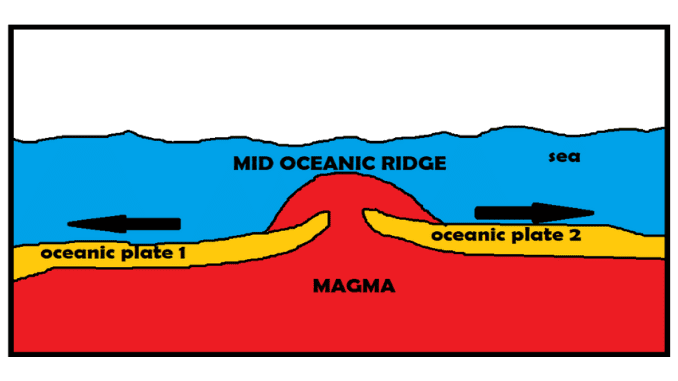
Mid-oceanic ridges
Mid-oceanic ridges form an interconnected chain of mountain systems within the ocean. It is the longest mountain chain on the surface of the Earth, though submerged under the oceanic waters.
Features of mid-oceanic ridges
- Are mountain-like structures standing well above the deep ocean floors.
- The mid-oceanic ridges are in total 65,000 km long and cover almost 23% of the Earth’s surface.
- These are rugged features and stand up to 1-3 km above the deep ocean floors.
- The most prominent feature of a ridge is its steep-sided central valley called a rift valley.
- Are formed along the boundary between two divergent tectonic plates.
- These zones are tectonically active regions; hence, small earthquakes occur frequently on crests of mid-oceanic ridges.
Geological Significance of Mid-Oceanic Ridges
They are as follows (1).
1. Magma generation
These are the places of intense volcanic activity, contributing to the generation of new oceanic crust.
2. Plate tectonics
Provide crucial evidence in support of the plate tectonics theory.
3. Heat outsourcing
Release huge amounts of heat through volcanic activity, influencing the Earth’s heat budget.
4. Mineral hotspot
Hydrothermal vent systems associated with mid-oceanic ridges are rich in minerals and metals, like copper, zinc, and precious metals like gold and silver, making them the potential targets for future mineral exploration.
5. Biodiversity protection
Also host a diverse variety of life forms, including some unknown species, offering insight into the limits of life on Earth.
6. Seismic activities
Seismic activities like earthquakes and tsunamis on the mid-oceanic ridges pose hazards to nearby coastal communities and infrastructure.
Anatomy of Mid-Oceanic Ridges
The structure of mid-oceanic ridges can be described in steps (2).
1. Central rift valley
Mid-oceanic ridges feature a deep, elongated depression known as the rift valley running along their axis.
2. Flank ridges
Flank ridges extend outward from the central rift valley along the flanks of mid-oceanic ridges. They are composed of volcanic rocks and exhibit a terraced morphology.
3. Fracture zones
These are also known as transform faults and are a very common feature in mid-oceanic ridges. These are areas where tectonic plates slide past each other horizontally.
4. Oceanic crust
The crust formed at mid-oceanic ridges is composed of basaltic rocks and is relatively thin compared to continental crust. It gets continuously created at the ridge and moves away as new crust forms.
5. Hydrothermal vent system
These are found along mid-oceanic ridges where hot, mineral-rich water is expelled from the seafloor. These vents support unique ecosystems and deposit mineral formations known as black smokers and white smokers.
Biodiversity and other activities on Mid-Oceanic Ridges
- Host diverse microbial communities adapted to extreme environments.
- These microbes play an important role in carbon, nitrogen, and sulfur cycles, contributing to the functioning of deep-sea ecosystems.
- Diverse communities of organisms like bacteria, archaea, tube worms, shrimps, crabs, and fish are part of the ocean ecosystem at mid-oceanic ridges.
- Important sites for scientific research, providing insight into seafloor spreading, plate tectonics, and the origin of life.
Evolution of Mid-Oceanic Ridges
Mid-oceanic ridges are characteristic of seafloor spreading. These are very active zones wherein new magma is expected to emerge on the ocean floor regularly. There are two processes responsible-
- Ridge-push- It occurs when the ridge pushes the tectonic plate away from the ridge, often towards the subduction zone.
- Slab-pull effect- At the subduction zone, slab-pull comes into effect.
They form new oceanic crust along divergent plate boundaries. They are formed when two plates move away from each other, causing fractures through which lava comes out and cools down, subsequently giving rise to oceanic crust. The older ones get pushed into the subduction zone as new crust keeps forming near the ridges.
Formation of subduction
Subduction zones get created where two tectonic plates converge. If one or both of the plates are oceanic, then a subduction zone will form. An oceanic plate will sink back into the mantle through the subduction zone.
Impact of Mid-Oceanic Ridges on Oceans
Mid-oceanic ridges play an important part in shaping the physical, chemical, and biological characteristics of the ocean by the following ways-
1. Harbors biodiversity
The unique habitats created by mid-oceanic ridges support a wide variety of marine life, making them biodiversity hot-spots.
2. Seafloor topography
Mid-oceanic ridges shape the topography of the seafloor, creating underwater mountain ranges.
3. Ocean water circulation
They influence oceanic circulation patterns by creating barriers to water flow and generating currents along their slopes. These currents transport nutrients and heat throughout the ocean.
4. Chemical influx
Mid-oceanic ridges contribute to the chemical composition of seawater through the release of minerals and gases. These inputs affect the pH level of the surrounding water.
Role of Mid-Oceanic Ridges in Plate Tectonics
It plays a very crucial role in the process of plate tectonics. They are mentioned as follows-
- They get created at divergent boundaries, where tectonic plates move away from each other.
- These are the primary areas where new oceanic lithosphere is created.
- The formation of new crust at mid-oceanic ridges pushes existing tectonic plates apart, driving their motion across the Earth’s surface.
- Are an essential component of the global tectonic cycle, which involves the continuous recycling of Earth’s lithosphere through geomorphological processes like seafloor spreading, subduction, continental collision, etc.
Q&A
1. What is a mid-oceanic ridge?
They are a seafloor mountain system formed by plate tectonics stretching nearly 65,000 kilometers.
2. Which is a characteristic of mid-oceanic ridges?
- Are mountain-like structures standing well above the deep ocean floors.
- They are total of 65,000 km long and cover almost 23% of the Earth’s surface.
3. What are the sites of the mid-oceanic ridge?
The major areas where mid-oceanic ridges are found are-
- Ridges at the Atlantic Ocean- The Mid Atlantic Range, the Reykjanes ridge, the Atlantic Indian ridge, etc.
- Ridges at the Pacific Ocean- Gorda Ridges, Caroline Ridge, etc.
- Ridges of the Indian Ocean- Ninety East Ridge, Chain Ridge, Hartog Ridge, etc.
4. Are mid-ocean ridges subduction?
No, mid-oceanic ridges are not associated with subduction; instead, they are associated with divergent plate boundaries.
Summary
- Mid-oceanic ridges are underwater mountain ranges formed by the divergence of tectonic plates.
- They play a crucial role in plate tectonics as they serve as sites for seafloor spreading.
- They help create new oceanic crust when magma upwells from the mantle and then solidifies to form new crust as plates move apart.
- Mid-oceanic ridges are geologically very important as they have intense magma generation, they outsource heat, they are the hotspot areas of minerals, and support biodiversity.
- Mid-oceanic ridges are concentrated around the Atlantic, Pacific, and Indian Oceans.
