
Introduction
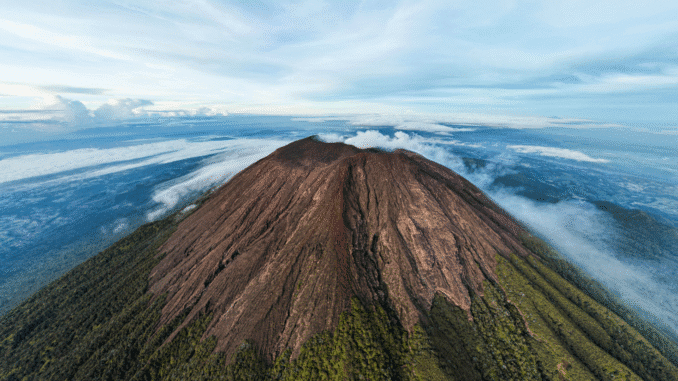
A stratovolcano, or a composite volcano, is made by alternating layers of pyroclastic materials and solidified lava. The pyroclastic layer is relatively thicker than that of the lava layer (1).
The layers of a stratovolcano are created by repeated explosive eruptions (producing ash, pyroclastic flows, and tephra). Effusive eruptions (producing slow-moving, viscous lava flows).
This layering creates their composite structure: Lava flows solidify into hard rock layers. Ash and pyroclastic material compact into weaker layers between lava flows.
- Composite volcanoes, also known as stratovolcanoes, are the most iconic and hazardous type of volcano.
- They are known for their steep, symmetrical cones and violent, explosive eruptions—making them both inspiring and deadly.
- Famous examples include Mount Fuji in Japan, Mount St. Helens in the United States, and Mount Vesuvius in Italy.
Formation of a Stratovolcano
Stratovolcanoes are built up over time by alternating layers, that is, the strata. of Lava flows, which are viscous, slow-moving
Volcanic ash, Tephra, which are the rock fragments. Pyroclastic deposits give them their steep, conical shape.
Stages of Stratovolcano Formation
1. Initial Eruptions (Basal Layer Formation)
- Magma rises from deep within the Earth’s crust, often at subduction zones (where one tectonic plate slides beneath another).
- The first eruptions are typically explosive, producing ash, pumice, and fragmented rock (tephra) that settle around the vent, forming a broad base.
2. Alternating Eruptions (Layering Process)
- Stratovolcanoes grow through a cycle of: Explosive eruptions (producing ash, pyroclastic flows, and tephra) and Effusive eruptions (producing slow-moving, viscous lava flows)
- This layering creates their composite structure: Lava flows solidify into hard rock layers. Ash and pyroclastic material compact into weaker layers between lava flows.
3. Cone Growth and Steepening
Due to the high viscosity of andesitic/dacitic magma, lava does not flow far, building up near the vent. Repeated eruptions steepen the slopes (typically 30–35° angles). A central crater forms at the summit, where most eruptions occur.
4. Secondary Features Development
Over time, stratovolcanoes may develop:
-
Lava domes
from thick, pasty lava clogging the vent.
-
Parasitic cones
Smaller vents on the flanks.
-
Calderas
If the volcano collapses after a massive eruption.
Unlike shield volcanoes, which are formed by fluid basaltic lava, stratovolcanoes are composed of more viscous andesitic or rhyolitic lava, which doesn’t flow as easily. This leads to the buildup of thick layers, creating their characteristic steep profiles.
Eruption Characteristics
Stratovolcanoes are notorious for their explosive eruptions due to
- High gas content in magma
- High viscosity of lava
- Trapping gases
- Building pressure
These eruptions can produce: Pyroclastic flows, that is, fast-moving hot gas and volcanic rock. They are unpredictable and are more dangerous than lava flows. Lahars that is deadly mudflows from melted snow and ash. Volcanic ash clouds are disrupting air travel and the climate.
Hazards and Benefits Dangers
Hazards
- Destructive eruptions can wipe out entire communities (e.g., Pompeii, 79 AD).
- Ashfall can damage crops, buildings, and respiratory health.
- Lahars and landslides can bury towns downstream.
Benefits
- Fertile soil from volcanic ash supports agriculture.
- Geothermal energy can be harnessed for power.
- Tourism attracts visitors to scenic volcanic landscapes.
There are also other types of volcanoes
