
Introduction
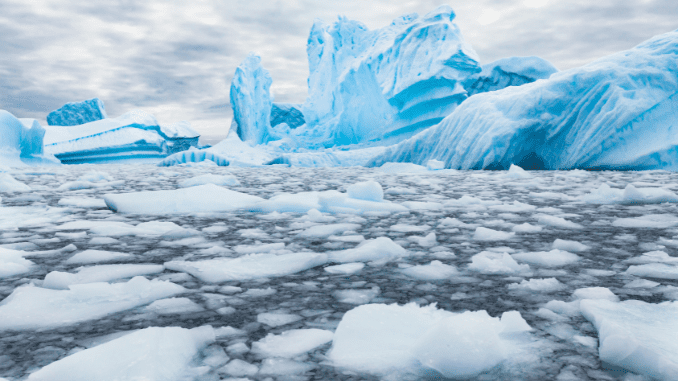
A polar ice cap or polar cap is a high-latitude region of a planet that is covered in ice. These are dome-shaped sheets of ice found mainly near the North Pole and South Poles.
Significance
Polar caps are important for the Earth and its survival because-
- Polar ice caps contain approximately 70% of the planet’s freshwater.
- They help to regulate the volume of water in the oceans.
- They categorically prevent the extreme rise of the sea level, hence maintaining the water level.
- They help in keeping the planet cool.
- The presence of polar ice caps helps in reflecting sunlight into space (1).
Formation of polar ice caps
- Polar ice caps form through the accumulation and concentration of snow over time.
- It completely covers bedrock and is generally dome-shaped with smooth surface slopes.
- The sizes range from 0.01 and about 20,000km2.
- They have formed for over 1000 years and are constantly building and breaking.
- Polar ice caps can be formed on land and sea.
- On land, they are formed over mountains with a 50,000 square km area.
- Antarctica and Iceland are the best examples of areas where polar ice caps are found (2).
Characteristics of polar ice caps
- The temperature is below freezing.
- The level of biodiversity is low in polar ice cap regions.
- Precipitation is less, even if it occurs, it is in the form of heavy snowfall.
- Portions of ice do not melt and get thicker up to 3-4 meters.
- Polar ice caps help in regulating the climate of the Earth.
- Winters are long and cold (3).
Role in the global climate
Polar ice caps play a crucial role in regulating the climate of the Earth in the following ways-
- They reflect sunlight that is received from the sun.
- Polar ice caps help in regulating the Earth’s temperature.
- They influence ocean currents and contribute to the global water cycle.
- The melting of polar ice caps contributes to the rise of sea levels.
- Polar ice caps help in the regulation of the greenhouse effect and help to reduce it.
Melting of the polar ice cap
The melting of the polar ice caps is occurring at a rapid rate. The reasons are as follows:-
-
Burning of fossil fuels
The burning of fossil fuel results in the increase of greenhouse gases, which leads to excessive heating of the Earth, for which polar ice caps are melt.
-
Global warming
The primary cause of the melting of polar ice caps is an increase in global temperature due to the accumulation of greenhouse gases like carbon dioxide, methane, etc.
-
Albedo impact
When ice melts, it exposes open surfaces that absorb more sunlight than reflective ice. This accelerates the melting of ice.
-
Deforestation
The rampant cutting down of trees gives rise to the concentration of carbon dioxide in the atmosphere, which in turn fastens the melting of polar ice caps.
-
Ocean warming
Warmer ocean temperature, due to climate change, contributes to the melting of polar ice caps (4).
Climate change and challenges
The melting of polar ice caps imposes various impacts, which are as follows
1. Rise in sea level
The melting of ice increases the sea level, posing the threat of flooding, especially to low-lying coastal areas and island nations.
2. Loss of habitat
Polar bears, seals, penguins, and other arctic species face a loss of habitat because of the rapid melting of ice.
3. Imbalance of the ecosystem
Changes in polar ice caps affect the polar biome, including species that depend on ice for breeding, hunting, and feeding, thus affecting the food chain.
4. Global climate change
The melting of polar ice caps influences climatic patterns, leading to shifts in weather systems, changed precipitation patterns, etc.
5. Increase in methane level
Thawing permafrost and the melting of ice caps release methane, which is a harmful greenhouse gas, contributing to climate change.
6. Effect on coral reefs
The rise of sea level due to the melting of polar ice caps affects the ecology of coral reefs and disturbs their habitat.
7. Shortage of electricity
In major parts of the world, electricity is dependent on the flowing water, which comes from the gradual melting of ice caps. But if the source is terminated, there will be an energy crisis faced by the world (5), (6).
Human impact on the polar ice cap
Human activities are the primary contributors to the melting of polar ice caps through the following ways-
1. Deforestation
Cutting down trees and forests reduces the Earth’s ability to absorb carbon dioxide, leading to the greenhouse effect. This accelerates the melting of polar ice caps.
2. Greenhouse gas emissions
The burning of fossil fuels, the cutting of trees, and industrial emissions lead to the release of large amounts of greenhouse gases. These gases trapped in the Earth’s atmosphere result in the melting of polar ice caps.
3. Industrial waste
Pollutants released from industries into the atmosphere contribute to the increase in temperature of earth.
4. Waste disposal
Improper disposal of waste in polar regions contributes to environmental degradation and the melting of ice caps.
5. Carbon deposition
Particles from the incomplete burning of fossil fuels settle on ice surfaces, reducing their reflective power and contributing to the melting of polar ice caps (7).
Q&A
1. What are the characteristics of an ice cap?
The following are the major characteristics of polar ice caps-
- Polar ice caps form through the accumulation and concentration of snow over time
- Polar ice caps contain approximately 70% of the planet’s freshwater.
- Polar ice caps help in regulating the climate of the Earth.
- The sizes range from 0.01 and about 20,000km2
2. What is the polar ice cap in geography?
A polar ice cap, also called a polar ice sheet, is a high-latitude region of land or water covered in ice.
3. What are the characteristics of plants in the polar region?
The following are the main characteristics of plants in the polar region-
- Polar plants are low-growing, which minimizes their exposure to the harsh polar climate.
- They have a short growing season.
- Polar plants are adapted to survive freezing temperatures.
4. What are the characteristics of arctic flora?
The following are the characteristics of arctic flora
- Arctic plants exhibit slow growth and have longer life spans.
- Mosses, lichens, and algae thrive in cold conditions, covering rocks and soil surfaces.
- Arctic flora have small and narrow leaves, which reduces surface area, minimizing water loss.
Summary
- A polar ice cap or polar cap is a high-latitude region of a planet that is covered in ice.
- These are dome-shaped sheets of ice found mainly near the North Pole and South Pole.
- Polar ice caps help in regulating the Earth’s temperature.
- They influence ocean currents and contribute to the global water cycle.
- Polar ice caps are slowly melting because of the greenhouse effect, deforestation, etc.
- The melting of polar ice caps leads to a rise in sea level, an increase in climate change, loss of habitat, etc.
- There are more human impacts on the melting of polar ice caps because of deforestation, burning of fossil fuels, etc.
- Changing environmental values and caring for the environment will restore the polar ice caps.
