
CRISPR
CRISPR is a type of gene editing technology which targets and eliminate a wide range of genetic disorders and life-threatening illness. It stands for “Clustered Regularly Interspaced Short Palindromic Repeats” .
According to a recent report in the journal Nature, the UK has become the first country to approve a CRISPR-based treatment for diseases. The therapy is called Casgevy, and it’s designed to treat genetic disorders like sickle-cell and beta-thalassemia (1).
Before diving into the CRISPR function and how it works let us go through the history of this technology.
The first phase is the Discovery era
- In 1987, researchers in Japan, Yoshizumi Ishino and his team from Osaka University in were the first to identify CRISPR in E. coli.
- They notice “repetitive sequences” in E. coli but aren’t sure of their purpose (2).
- In 2002, Francisco Mojica officially coined the term CRISPR which is “Clustered Regularly Interspaced Short Palindromic Repeats” (3).
- In 2005 Mojica along with others discovered that the “spacer” DNA in CRISPR matches the DNA of viruses.
- And conclude that CRISPR is a bacterial immune system.
The Breakthrough Era (2012–2013)
- In this period, the functionality and importance of CRISPR in prokaryotes were realized which leads to the development of a revolutionary genetic engineering tool.
- This is when CRISPR moved from a “natural defense” to a “programmable tool.”
- Jennifer Doudna and Emmanuelle Charpentier publish their landmark paper. They show that you can “reprogram” the system to cut any DNA sequence you want by changing the guide RNA (4).
- In the year 2013, Researchers like Feng Zhang and George Church prove that CRISPR works in human cells. This opened the door to treating genetic diseases in people (5).
The Clinical Era (2020–Present)
- Research has now shifted from the lab to real patients.
- Doudna and Charpentier are awarded the Nobel Prize in Chemistry for their discovery.
- UK and the US (FDA) approve Casgevy, the first-ever CRISPR drug to treat sickle-cell disease.
How CRISPR Works?
- In nature, CRISPR is not a laboratory tool but a sophisticated immune system used by bacteria to fight off invading viruses (bacteriophages).
- The process works like a “genetic memory” that allows the bacteria to recognize and destroy specific enemies.
- Emmanuelle Charpentier and Jennifer Doudna discovered CRISPR–Cas by chance while studying how bacteria defend against viruses.
The process happens in three distinct stages:
1. Adaptation (Building the Memory)
- When a virus infects a bacterium for the first time,
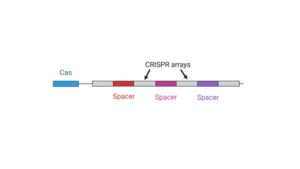
- The bacterium uses specific enzymes to “snip” a small piece of the viral DNA.
- It then pastes this snippet into its own genome within the CRISPR array.
- These viral snippets are called spacers.
- This acts as a “Most Wanted” gallery, keeping a permanent record of the virus’s genetic signature.
2. RNA Biogenesis (Creating the Scouts)
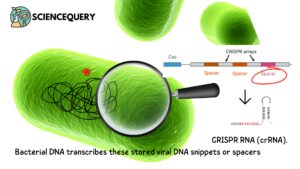
- The bacterium then transcribes these stored viral DNA snippets into small molecules called CRISPR RNA (crRNA).
- Each crRNA molecule carries the code of a specific virus.
- The crRNA then binds with a “cutting” protein called Cas9.
- Together, they form a surveillance complex that patrols the inside of the bacterial cell.
3. Interference
If the same virus tries to infect the bacterium again, the crRNA-Cas9 complex recognizes it instantly by following these steps
Search for the virus
The crRNA-Cas9 complex floats through the cell until the crRNA finds a perfect genetic match in the invading viral DNA.
PAM recognisition
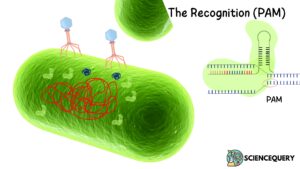
The Cas9 protein first looks for the PAM sequence (the “safety lock”) on the virus to ensure it is attacking the enemy and not its own genetic library.
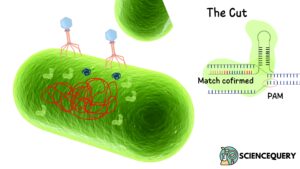
Cutting of viral DNA
Once the match is confirmed and the PAM is found, the Cas9 enzyme acts like molecular scissors, cutting the viral DNA into pieces. This effectively kills the virus and stops the infection.
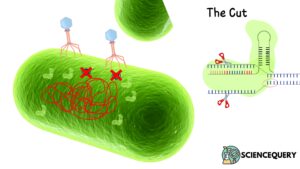
The inventors realized that this natural process could be harnessed for the future of medicine (Strzyz, 2020).
CRISPR Structure
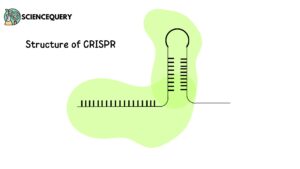
Is made up of two different parts
- The enzyme part
- The RNA part.
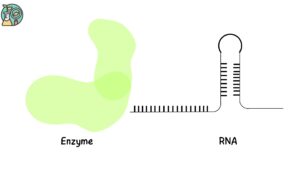
The Enzyme part
- The enzyme part of the CRISPR system is the actual “molecular scissors” that do the cutting.
- Cas9 is the widely used enzyme which stands for CRISPR-associated protein 9.
- Cas9 enzyme is the machinery that travels to the destination and performs the physical operation.
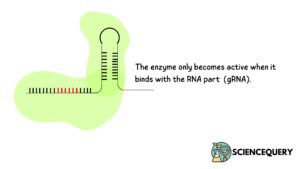
- The enzyme only becomes active when it binds with the RNA part the guide RNA (gRNA).
The RNA part
- Once the guide RNA is loaded inside the enzyme, Cas9 changes its 3D shape, becoming an active.
- Surveillance machine ready to scan the genome. This combined structure is called a Ribonucleoprotein (RNP) complex.
The Two Main “Lobes” of the RNA
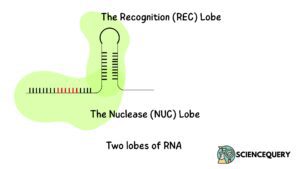
Biologically, the Cas9 protein is divided into two distinct regions or “lobes” that have different jobs:
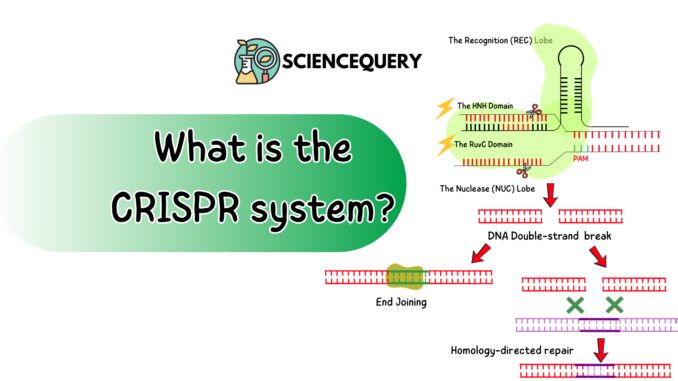
1. The Recognition (REC) Lobe: This part acts like the hands holding a map. It binds to the guide RNA and helps position the target DNA so the genetic sequences can be compared for a match.
2. The Nuclease (NUC) Lobe: This is the cutting machinery. It contains the active sites that will eventually sever the DNA strands.
The Dual-Blade System (HNH and RuvC)
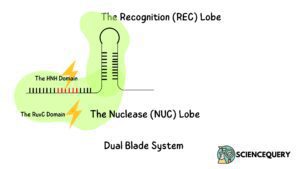
- DNA is double-stranded (a double helix). To effectively disable a gene or allow for editing, Cas9 must cut both strands to create a “double-strand break.”
- To do this, the Nuclease lobe uses two separate cutting domains, acting like a pair of dual blades:
- The HNH Domain: This chemical “blade” cuts the DNA strand that perfectly matches the guide RNA (the complementary strand).
- The RuvC Domain: This “blade” cuts the opposite DNA strand (the non-complementary strand).
The Sequence of Action in CRISPR
- When Cas9 finds the PAM sequence that is a the safety lock. It physically grabs the DNA.
- The enzyme then unzips the DNA double helix, pulling the target strand into its core to pair with the guide RNA.
- If the match is perfect, the HNH and RuvC blades are triggered, snipping both sides of the DNA ladder.
- Once the DNA is cut, the cell’s natural repair mechanisms kick in, and that is exactly when scientists can introduce new genetic material to edit the gene.

What happens after the DNA is cut?
After the DNA is cut, the cell will follow either of the two processes
1. NHEJ—or Non-Homologous End Joining.
2. Homology directed repair
Let us discuss both process one by one.

1. NHEJ—or Non-Homologous End Joining.
- When the cell detects a double-strand break, its first instinct is damage control. It wants to glue that broken strand back together as fast as possible.
- This process is called NHEJ—or Non-Homologous End Joining.
- NHEJ acts like a duct tape. It doesn’t use a blueprint; it just grabs the two loose ends and joins them together.
- This results in short insertion or deletion (collectively termed indels)
- Scientists use this pathway on purpose when they want to turn off a harmful gene—like disabling a gene that causes a disease.
The Pro: It’s fast, and it works all the time.
The Con: It’s messy.
2. Homology directed repair (HDR)
- Here the homology repair tempelate can be provided by either Double stranded DNAs via plasmids or viral vectors or can be synthetise the single stranded DNA
- The cell looks for a blueprint.
- Scientists can trick the cell by feeding it a custom-designed piece of “donor DNA” alongside the CRISPR tool.
- The cell uses this donor template as a reference guide, carefully copying the correct sequence to fill the gap.
The Pro: It is 100% precise. You can edit individual letters of the genetic code.
The Con: It’s much harder to trigger, and cells only do it naturally during specific phases of cell division.
Applications of CRISPR Technology
- By using crispr technology we can delete a gene or we can also insert a desire gene at specific location. Therefore there are so many applications of CRISPR technology
- Genetic Disease Treatments: Approved therapies like Casgevy edit hematopoietic stem cells ex-vivo to treat sickle cell disease and transfusion-dependent beta-thalassemia.
- Oncology & Immunotherapy: T cells engineered ex-vivo via CRISPR-mediated knockouts boost immune targeting against tumors in CAR-T cell therapies.
- In Vivo Gene Therapy: Direct delivery systems target liver and eye tissue mutations, addressing conditions such as transthyretin amyloidosis.
- Antiviral Defense: Experimental applications disrupt latent viral genomes integrated into host cells, including HIV and HPV.

Leave a Reply